:::: MENU ::::

Weekly Debt Update #21- New Budget

by

Hey everybody! Happy Tuesday!

I want to share with everyone what I’m going to start using as my new budget now that I’m on the 2nd phase on my debt payoff.

But before I do that, I want to tell you quickly about my weekend. It was mys father’s 55th birthday, so we went up to Buffalo to celebrate and hangout. Much like I did for Mother’s Day (here), GF and I went to hard made route for my Father’s Day. Instead of doing the fresh cut flowers and a letter, I picked up a 6 pack of a beer I know he hasn’t tried (he’s really into beer tasting) and made the card myself. It’s by no means a work of art, and even though it looks like a child made it, I assure you the handy work was all mine:

Dad Card

(Yes, we are HUGE Bills fans, if you couldn’t tell, lol)

I did the drawing free hand using an image from Google Image Search as a guide and filled it in using water colors. I personalized a little inscription on the inside basically telling my dad how much we appreciate him, This was my first attempt at really creating something as a gift, and though it is simple, I  could tell my dad really appreciated it. I feel I’m going to have a lot more crafting in my future. As for GF, she made an absolutely delicious salsa using the vegetables from our garden for him (read about it here), which she then wrapped up in a little container with a bow. So between the beer, the salsa and the card, I think we did pretty good.

As for my budget, I’ve added a some line items, because of lumping everything into a catch all  “Miscellaneous” category for all items that I don’t have planned for.  I’ve also added a car maintenance line to take car of items like oil changes and repairs. Here’s what it looks like:
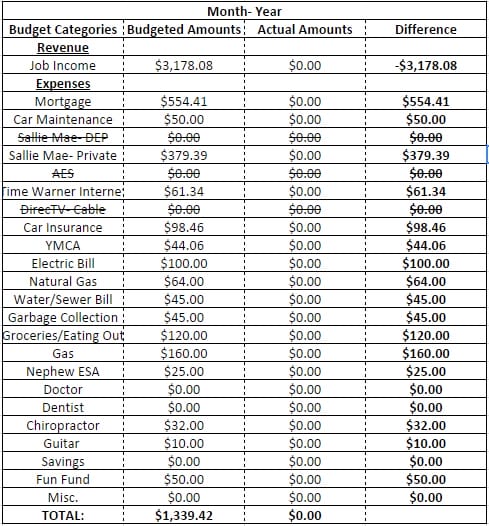
New Budget


For comparisons sake, here is what I was using:
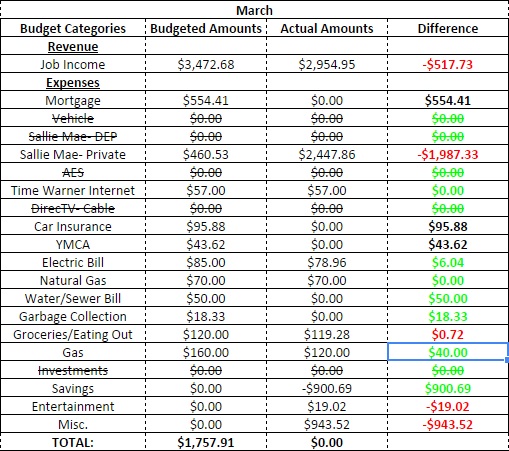
Weekly Update #9


So…what do you guys think?

And lastly, here are my new debt balances since last week:

Loan NameInterest RateOriginal Balance- May '09Current BalanceTotal Paid OffPaid Since Last Week
Sallie Mae 015.25$27,837.24$23,776.95$4,060.29$0.00
Sallie Mae 024.75$22,197.02$18,651.56$3,545.46$0.00
Sallie Mae 037.75$20,692.10$0.00
$20,692.10$0.00
Sallie Mae 045.75$10,350.18$5,310.59$4,867.47$443.12
Sallie Mae 055.25$6,096.03$0.00$6,096.03$0.00
Sallie Mae 06 and 074.75$6,415.09$0.00$6,415.09$0.00
Sallie Mae- DOE 015.25$5,000.00$0.00$5,000.00$0.00
Sallie Mae- DOE 025.25$3,000.00$0.00$3,000.00$0.00
AES6.8$9,000.00$0.00$9,000.00$0.00
TOTALS$110,587.66$47,295.98$63,291.68$443.12

I hope everyone has a great week!

Summer Book Club Review: Your Money or Your Life

by

I’m a little late with my review, as Your Money or Your Life was supposed to be our July book for our summer book club and I just finished it. Better late than never, right?

In June I reviewed Dave Ramsey’s Complete Guide to Money. Feel free to check that out, too!

Now, onto this review.

FullSizeRender-3

For some reason, I had a really hard time getting into this book. There’s an introduction and a prologue and I swear it took me 3 weeks to get through those few pages. But once I finally got into the first chapter, the book drew me in a bit more and I devoured it pretty quickly.

I definitely didn’t agree with everything the authors said. They start laying their argument by discussing how miserable many people are in their jobs:  the long commute, battling traffic, doing mindless work, and always looking forward to 5:00pm or punch-out time. They call it “making a dying” (instead of making a living). I have to say, this perspective really didn’t resonate with me at all. I think partly because I really love my job, partly because its still so fresh and new (and I’m just so grateful to have it), and partly because I don’t have the typical 9-5 job. There’s a little more flexibility and I find it to be challenging but enjoyable at the same time. So the way they framed the book really didn’t appeal to me. I felt like it was written for someone else.

That being said, I still really enjoyed the content. Some of the figures the authors present are really compelling – on average we have $8,000 of consumer debt for every man, woman, and child in the United States. Savings rates in 2007 were less than 1 %, compared to a 10.9% rate of savings in 1981.

The book was a little dated (and, therefore, so are the figures presented), but the core message is clear:  We spend our whole lives working and have nothing to show for it. No savings and lots of debt. So from that perspective, we’re certainly a slave to our jobs.

I also really enjoyed the various thought provoking exercises. Again – I didn’t feel that everything necessarily applied to (or helped) me, personally. Though I think much of that is because I’m already committed to my debt-reduction journey. If I read this book 3 years ago when I was still just contemplating tackling my debt (before I’d taken real and active measures to actually pay down debt) I think it would have been much more beneficial. Even so, there were several activities that still appealed to me.

Step 2 in the program is to “track your life energy.” The authors give two simple instructions to complete this step: “a) Establish the actual costs in time and money required to maintain your job, and compute your real hourly wage, and b) Keep track of every cent that comes into or goes out of your life.” The purpose of this activity is to step back and really assess our true income, after taking all job-related time and expenses into consideration (e.g., work clothing, commute time, lunches at the office, evening e-mails, etc.)

The authors pose the question: “If you didn’t need [your] money-earning job, what time expenditures and monetary expenses would disappear from your life?”

I also like how the authors continually push back against the traditional job scenario (the 40 hour work week for 40 years). They teach readers to think in terms of overall life values, satisfaction, and fulfillment and to examine how behaviors might change if work were not a requirement of survival. They challenge our culture’s very idea of “fulfillment” and explain the thin line between “enough” and “excess.” They teach the pleasures of frugality – of spending less, but enjoying more.

Overall, nothing was really rocket science in this book. They provide strategies to decrease spending and live a happier, more fulfilling life with less. But I liked how they tied together many psychological and even spiritual (to some extent) elements to make a case for the importance of changing our outlook on life:  to place more value on our time and less value on “stuff.”

I think this book would be particularly beneficial for those just starting (or thinking of starting) their debt-reduction journey, or for those who are struggling with budgeting.

If you’ve read this book, what did you think? Have you read any other good financial books or articles lately? (feel free to link in comments)